
Loading the map…
Carry the Truth
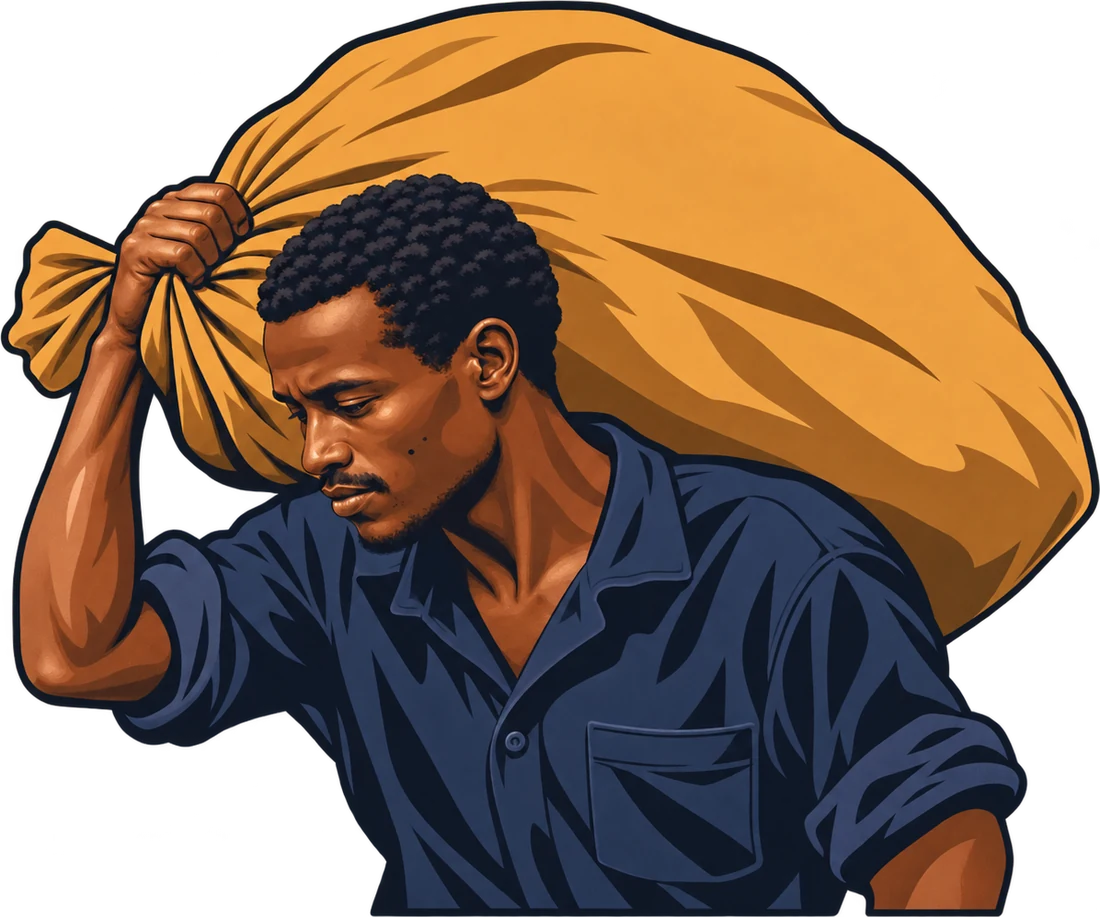
A standard sack of coffee weighs 60 kilos. A sack of cocoa weighs up to 65. Before either reaches a shipping container, a person lifts it by hand, and lifts the next one, and the one after that. In a European warehouse, employers are required to avoid that lift wherever they reasonably can, so a forklift does it. At origin, nobody has even measured it.
The problem
Sixty kilos is roughly the weight of an adult. A 1990 EU directive requires employers to avoid the need for workers to handle loads by hand wherever that is reasonably practicable, which is why these sacks move by forklift in European warehouses. It sets no kilogram limit, and its duty does not reach the farm, the buying station or the mill at origin.
Low back pain is the world's leading cause of years lived with disability, affecting 619 million people. Across eight long-term studies, every extra 10 kg lifted raised the odds of new back pain by about 11 per cent. A 60 kg lift is about 2.6 times the recommended limit, in ideal conditions.
No published trial has ever tested a lighter bag in coffee or cocoa. The trade records altitude, moisture, variety, cup score and carbon footprint to the decimal point. It does not record the weight on the person who carries the lot to the door.
Nobody chose 60 kilos for safety. The International Coffee Agreement of 1962 defined a bag as “60 kilogrammes … of green coffee” so that countries could count the crop in one measure, and the 2022 Agreement still does. But 1962 did not invent the number. It wrote down one the trade had used for a century, and that one came from an animal.
Brazil, where the sack began, has always counted coffee in arrobas. An arroba is 15 kg and a sack is four of them – still true this morning, since the arroba price a Brazilian farmer uses is the 60 kg sack price divided by four. The word is Arabic, ar-rubʿ, “the quarter”: a quarter of a quintal, and the quarter in question is said to be a quarter of what a pack animal could carry.
If that sounds like etymology rather than evidence, look at Colombia, where the animal never left. Colombian coffee is not bought by the kilo or by the sack. It is bought by the carga – the word means load – and a carga is 125 kg, which the reference works define as two sacks of coffee. The National Federation of Coffee Growers publishes that price every working day of 2026.
Two sacks. One for each side of the animal. A unit of account became the weight a person carries, and an accounting rule has no shoulders.
The link between the arroba and the animal is trade lore rather than documented fact, and there are competing accounts. The carga is not lore: it is in the dictionaries, in a 1966 UN reference, and in today’s price sheet. What no version of the story contains is anybody measuring a person. The longer version is on the About page.
For scale
Sixty is an easy number to read past. It is harder to read past when you count it out in things you have actually picked up.
Rounded, from ordinary published weights for each item. The point is not the decimal place. It is that every one of these is something a person would think twice about carrying across a yard, and a sack of coffee is all of them at once.
The evidence
Loading…
Our demands
Coffee and cocoa move in bags of 60 to 70 kg because that is how they have always moved. Nothing in law requires it, and every modern standard says it is too heavy. Four groups can change it.
Fill to 25 kg at origin, where the sack is first lifted. Cement plants in four countries re-rigged their packing lines within a few years; the machinery is the same problem.
Ask what the bag weighs, then write it into the purchase specification. Coffee is already priced by weight, not by the sack, so the trade does not need the 60 kg unit to price a lot. Smaller sacks do use more jute per tonne, and buyers should expect to carry that cost.
Add a maximum sack weight to the standard. No voluntary sustainability standard in coffee or cocoa currently sets one.
Set a figure for adult men where the law is silent, and cover bagged commodities in the ILO's new manual-handling standards, due in 2029 and 2030.
It has been done before
France cut its cement sack from 50 kg to 35 kg in 2002 after back injuries among masons. Chile legislated a 25 kg handling limit in 2017 and the bags followed. Mexico's producers switched in 2024 to comply with an ergonomics standard, Argentina made 25 kg a legal requirement in 2025, and Brazil's producers must finish by the end of 2028 or face daily fines. Coffee and cocoa have not started the conversation.
Take action
Country by country
Colour the map by the test you care about, then click a country for its legal limits, its treaty ratifications and the bag weights in use. Every figure names the law or source it came from.
The law
We searched the labour law of all 187 ILO member States for a maximum carrying weight. We have examined 157 of them and reached a determinate answer for 134. Almost none name 60 kg as acceptable. Most simply never wrote a number for adult men – they protect women and children by the kilo and leave men to a general duty of care.
Counts come from the same country file as the map. "No kg limit" is not the same as "allowed": several of these countries treat 50–70 kg as unacceptable in their inspection guidance.
Headline maximum for one adult man. Red line: the 60 kg coffee bag. Click a country to open its file on the map.
Every Spanish-speaking coffee origin where we found a figure caps one man below 60 kg: Mexico 25, Ecuador 23, Guatemala and Bolivia 45, Honduras 45.4, Colombia and Paraguay 50, Nicaragua 55 only in "very special circumstances". Peru allows 50 kg on the shoulder only with someone helping the lift.
Brazil's labour code (CLT art. 198, wording from 1977) caps at exactly 60 kg what one employee may remove individually. It is a ceiling, not a licence: it does not cover loads moved on handcarts or other mechanical aids, and women and minors have separate, lower limits. In April 2026 a coalition of Brazilian safety bodies, including the labour prosecution service, wrote to Congress asking for a 25 kg reference. Haiti – 80 kg for sacks, under a Code we have read in the ILO's database rather than a Haitian gazette – is the only other country we could answer where the law on its face allows it.
Partly, and the part that bites is newer than most people realise. ILO obligation comes in three layers, and almost every coffee and cocoa origin sits in at least the second.
Joining the ILO does not import its standards into national law. But in June 2022 the International Labour Conference added a safe and healthy working environment to the Fundamental Principles and Rights at Work, alongside freedom of association, forced labour and child labour. The ILO’s own wording is that all Members, even if they have not ratified these two conventions, now have an obligation arising from the very fact of membership in the ILO to respect, to promote and to realize
that right. No court will enforce it. But it is a promise every one of those governments has already made, out loud, with their employers’ and workers’ organisations sitting beside them. Nobody has to be persuaded that the principle is right. They have only to be asked whether a 60 kg sack honours it.
Conventions bind only on ratification. 94 States have ratified C155 on occupational safety and health and 78 have ratified C187 on the framework for it; both became fundamental Conventions in 2022. These require a national OSH policy built on prevention, with the adaptation of loads to workers rather than workers to loads. They require loads to be adapted to the worker rather than the worker to the load. What they never do is say how heavy is too heavy – and a sack that nobody ever weighed against a rule has sat in that silence for a hundred years.
One convention speaks directly to the sack. C127, the Maximum Weight Convention 1967, says no worker shall be required to carry a load which, by reason of its weight, is likely to jeopardise his health or safety
, and that limits for women and young workers must be substantially lower. Its companion Recommendation No. 128 puts the figure for one adult man at 55 kg. 29 countries are bound by it. Twelve of them are coffee origins – Brazil, Costa Rica, Ecuador, Guatemala, Honduras, India, Madagascar, Nicaragua, Panama, Peru, Thailand and Venezuela – and eleven of those are cocoa origins too. Not one of them has a 60 kg sack written into its law.
Select How far does ILO law reach? on the map to see which layer each country sits in. The seven UN member States outside the ILO – Andorra, Bhutan, the Democratic People’s Republic of Korea, Liechtenstein, Micronesia, Monaco and Nauru – carry none of these obligations; none is a coffee or cocoa origin. Ratification counts are from our country file; the ILO’s NORMLEX database was unreachable when we last tried to re-confirm them.
The right exists and it is explicit. Article 7 of the International Covenant on Economic, Social and Cultural Rights guarantees everyone safe and healthy working conditions
, and the UN committee that interprets it spelled out in 2016 what that requires of states, including over the overseas operations of their companies. 172 States are parties to the Covenant.
What the right does not do is name a weight. No human rights instrument says 60 kg is too heavy, just as no labour code says it is acceptable. The sack sits in the same silence in both systems.
What it does do is move the question off the farm. Under the UN Guiding Principles on Business and Human Rights, and now under EU due diligence law, a company is expected to find and address the harm in its own supply chain – not simply to point at the law of the country it buys from and say that nothing there was broken.
A 60 kg sack is lawful in most origins because nobody ever wrote a number. That does not make it light. Somebody’s spine carries the difference, and a buyer can be asked what they intend to do about it.
We are not claiming a legal breach. We are claiming that every framework a buyer already signs up to – the ILO’s fundamental principles, the Covenant, the Guiding Principles, their own due diligence policy – points the same way on this, and none of them is being applied to the weight of the bag.
The sack does not stop being heavy when it reaches Europe. It is lifted again in Hamburg, in Antwerp, in Trieste, by someone whose back is covered by European law. There is no EU rule setting a maximum weight for a sack of goods – cement reached 25 kg here through national agreements and company decisions, not a regulation. But four EU instruments put the bag in front of someone who has to answer for it, and the first one applies today.
Green coffee is lifted by hand in Hamburg, Antwerp, Trieste, Amsterdam, Barcelona and Le Havre by workers covered by Directive 90/269/EEC on the manual handling of loads. It sets no kilogram figure. It requires the employer to avoid manual handling where mechanical means are possible, to assess what is left, and to tell workers the weight of the load. Its Annex I names a load that is too heavy or too large
as the first risk factor.
The numbers live in the national transpositions, and several sit below 60 kg:
These are each country’s own figure for one adult man, whether set in regulation or in the labour inspectorate’s guidance. Open any of them on the map for the instrument and the wording.
From 30 December 2026 the EU Deforestation Regulation applies to coffee and cocoa for large and medium operators, and from 30 June 2027 for most small ones. It requires more than deforestation-free: a commodity must be produced in accordance with the relevant legislation of the country of production
, and article 2(40) lists labour rights among the categories of law that counts.
Twenty-seven origin countries cap what one adult man may carry below 60 kg. On the face of it, a 60 kg sack filled and carried by one person in those countries is not produced in accordance with that law.
Lawyers will push back on that, and they should be heard. Article 2(40) ties the legislation that counts to the legal status of the area of production; some read the Commission’s guidance as pushing labour rights to the margin; and industry opinions argue the duty is to try, not to guarantee. None of that has been settled. We set it out here as a question the trade now has to answer, not as a verdict.
CSDDD reaches fewer companies than most people think. The Omnibus I Directive (EU) 2026/470, in force 18 March 2026, raised the threshold to more than 5,000 employees and €1.5bn turnover and pushed application to 2029. It now reaches only the largest buyers – roughly 6,000 companies across the whole economy, where the original would have caught about 13,000. For most roasters, mandatory EU due diligence is out of scope.
EmpCo, Directive (EU) 2024/825, has applied since 27 September 2026 with no transition period, including to stock already on shelves. It raises the bar for what a trader can claim and for the sustainability labels they display. A roaster that tells consumers something about the welfare of the people who grew and moved its coffee now has to be able to stand behind it, and the weight of the sack is part of that story.
What we are not saying. We are not saying that anyone shipping a 60 kg bag is breaking EU law. No EU instrument sets a weight for a sack, the EUDR reading above is untested, and CSDDD will not reach most of the industry. What we are saying is simpler. The bag is already handled here, under a directive that tells the employer to bring the risk down and to tell the worker what they are about to pick up. Nine member states have written their own figure, and every one of them is below 60. And from the end of December, how coffee and cocoa were produced becomes a condition of selling them in Europe at all.
The Dutch labour inspectorate says loads of 50 kg or more may not be lifted by hand, not even with several people
. Denmark's guidance puts 60 kg in its red zone. Ireland's regulator notes its rules set no weight limit at all. Africa's cocoa and coffee origins mostly protect only children and women.
Precedents
Cement is the closest precedent: a heavy bagged commodity whose national industries redesigned their packing lines around a lighter unit, mostly within a few years of a legal or reputational trigger.
None of these national switches has been followed up with injury data. The one controlled test of a lighter cement bag found that halving it cut the peak load on the spine but raised the cumulative load across a shift, because two lifts replace one; the workers themselves preferred the lighter bag. That is an argument for pairing a lighter sack with changes to how the work is organised, and for measuring the result. Davis et al., 2010
Ley 19.927 (2020) and Decreto 323/021 set 25 kg as the most a worker may be required to handle by hand, for bags of building materials, human food, fertiliser and animal feed. The decree expressly allows heavier bags, national, imported or for export, where they are moved by mechanical means. So it is not a packaging ban, but it is a national rule that names 25 kg for the sacks people lift.
Zambia's and Malawi's food reserves and the Philippines' NFA work in 50 kg bags. Brazil prices maize per 60 kg saca, the same unit as coffee. Ghana's buffer-stock company buys maize per 100 kg bag, Pakistan's PASSCO buys 100 kg wheat bags, and Nigeria quotes maize per 100 kg.
Sources are listed for each country on the map (colour by "Standard grain/maize sack").
Kenya's Crops (Food Crops) Regulations 2019 require staple grains to be packed in units of 50 kg or less. The National Cereals and Produce Board still buys maize in 90 kg bags. A Senate inquiry opened in August 2025; no outcome was found by November 2026.
By 2015 about half of Brazil's green coffee exports shipped in bulk container liners. Exporters cited cost, speed and worker-injury lawsuits; one forklift driver filled a container in 25 minutes that took nine men nearly an hour with jute bags. The cost was jobs – one Santos firm went from 59 lifters a shift to 9. A 25 kg bag is the option that keeps the job and halves the load.
Cocoa
Cocoa has been examined more closely than almost any agricultural commodity on earth. Child labour, deforestation, living income, traceability, forced labour, gender: each has been measured, benchmarked, legislated for and reported on annually for more than a decade. The weight of the sack has never once been on the list.
Ghana’s Cocoa Board sets its producer price against a 64 kg bag. Côte d’Ivoire works in 65 kg. Both are heavier than the coffee sack, and in both countries the first movement is usually a farmer or a hired carrier taking the bag from the farm to a buying station on a head, a shoulder or a bicycle, over ground that no forklift will ever reach.
Neither figure appears in either country’s labour law. Côte d’Ivoire’s decree sets 25 kg over ten metres as the limit for a woman and 10 kg for a pregnant worker. For an adult man it sets nothing at all.
Cocoa is the more fragmented of the two chains: the beans in one container may come from hundreds of smallholdings, aggregated through buyers and co-operatives before anyone from a company sees them. That fragmentation is exactly why cocoa built traceability systems ahead of coffee, and why the EU Deforestation Regulation bites harder here.
It also means the lifting is done furthest from anyone who could be held responsible for it. The sack is heaviest, the oversight is longest-established, and the one measurement nobody took is the one a person feels.
The Cocoa Barometer, published by the VOICE Network, has assessed the sector’s traders, processors and brands on price, child labour, deforestation, traceability and living income across successive editions. Occupational injury from load handling does not appear among the indicators. We say this as an observation rather than a criticism: it has not been on anyone’s list, including ours, until now.
The evidence
Standards and guidance are for lifting under good conditions; national laws are headline maxima for one adult man. Bag weights are trade conventions.
as speedily as possible. In March 2026 its Governing Body put ergonomics and manual handling on the International Labour Conference agenda for 2029 and 2030, for a standard-setting discussion across those two years. R128 · GB.356
Scrutiny
These are the arguments the trade makes against a lighter sack. Some of them are good. We have tried to set out each one as its strongest version, and to say plainly where it defeats us.
True, and we should stop pretending otherwise. A jute sack takes roughly the same amount of jute whether it holds 25 kg or 60 – the ICE contract rules require 700 g of jute per bag regardless of size – so a lighter unit needs about 2.4 times the sacking per tonne. There is also more filling, more stitching, more stacking and more labour per tonne.
The honest arithmetic: a tonne of coffee takes about 17 sacks at 60 kg and about 40 at 25 kg. At the ordinary price of a jute sack, that is a difference of a few tens of dollars on a tonne of green coffee worth several thousand. It is a real cost and somebody has to carry it. We think it should be the buyer, and we have said so.
This one is the wrong way round. A 20-foot container takes 275 to 320 sacks at 60 kg, and 560 to 640 at 30 kg – the same tonnage, double the handling. Lighter sacks mean more lifts and more work, not less.
What actually removes the job is the bulk container liner, which carries about 21 tonnes against 18 in bags, at roughly 15% lower freight cost per kilo, and needs almost nobody to load it. When Santos moved to bulk, one terminal went from 59 lifters a shift to nine. The 60 kg sack’s competitor was never a 25 kg sack. It is the liner, and the liner is winning.
Where it is possible, it should be done, and in European warehouses the law already requires employers to avoid the manual lift wherever reasonably practicable. But mechanisation at the port does nothing for the first lift, which happens on the farm, at the buying station and at the mill, where there is no forklift and will not be one soon. That is where the weight is set and where it is carried.
This is the strongest objection and we cannot dismiss it. When Davis and colleagues halved a cement bag, peak spinal compression fell by about a quarter but cumulative load across the shift rose, because two lifts replaced one. Peak load is associated with acute injury; cumulative load with wear.
Which matters more for a sack of coffee carried up a slope is not known, and that is precisely why we are asking for the measurement rather than asserting the answer. It also means a lighter sack on its own may not be enough: pace, staffing and mechanical aid have to change with it. Nine of the ten workers in that study still preferred the lighter bag.
Partly fair. We are not aware of an origin-led campaign on bag weight, and that is a weakness in this work rather than a point in its favour – which is why we are asking unions and producer organisations to shape the question rather than answer ours. But the sector has not been asked either. No survey, no consultation and no study has ever put the question to the people who carry the sacks, and the absence of a demand for something nobody has been offered is not consent.
There is no measurement, which is not the same thing. Low back pain is the world’s leading cause of years lived with disability, and across eight long-term studies each additional 10 kg lifted raised the odds of new back pain by about 11%. Every modern lifting benchmark lands between 15 and 25 kg for an adult man in good conditions.
What is missing is a figure for this specific load, in this specific work. An industry that measures altitude, moisture, screen size, cup score and carbon footprint to the decimal point has never measured this one. That is the finding.
The opposite, if anything. Under the EU Deforestation Regulation every plot contributing to a consignment must be declared, and a single non-compliant plot taints the whole consignment regardless of its share. Bulk commingling therefore concentrates risk: one bad farm in a 21-tonne liner compromises all of it. A smaller, segregated, identifiable lot is finer-grained traceability, not coarser – and for the first time in sixty years, the question of how big the traceable unit should be is commercially live.
If you think one of these is answered badly, or you have the argument we have missed, we would rather hear it before someone else makes it in public. The letter explains how to reach us.
Key facts
Each fact links to the law, standard or study it comes from. Under each one we say plainly what it does not show, so you can judge the evidence for yourself.
Each of these facts is also a campaign card built for sharing, with its figure and its sources on it. See all 27 cards. #WhatDoesYourCoffeeWeigh
The cards
Each card takes one piece of the argument and shows the evidence behind it. They are built to be read on their own and passed on. Click to open one; every card names its sources.
Take part
This campaign argues that the standard 60 kg sack is far above every modern benchmark for what one person should lift. It does not argue that the health consequences have been measured, because they have not. The gap is the point, and closing it is what we are asking for help with.
We should be straightforward about what this campaign is. It is a desk review and an argument. There is no field team, no funding, no laboratory and no study under way. What we have done is establish that the question is open, that it is answerable with ordinary occupational health methods, and that the legal and commercial ground is already prepared. We cannot answer it ourselves.
So there are two asks, and they are different. The first is practical: people and institutions who can help design and carry out the research – or who can contribute a piece of it, however small. The second is advocacy: people willing to argue, in the rooms we are not in, that this is worth measuring. The second may matter more than the first. Nothing gets measured until enough people think the question is a real one.
What follows is an outline of what the work would need to cover, not a protocol. The protocol is for whoever leads it to write.
The same letter is going to about 158 organisations – traders, roasters, retailers, chocolate brands, national coffee and cocoa boards, certifiers, development agencies, unions, regulators and NGOs. The full text is published, the recipients are named, and every reply, acknowledgement or silence is recorded beside the name.
For the avoidance of doubt
We think the answer is a 25 kg sack, the weight the international lifting standard treats as its outright ceiling. We are not asking anyone to commit to that before it has been measured – that is the whole point of the research. But it would be evasive not to say plainly where we think this ends up, so here it is, and here is who would have to move.
Fill to 25 kg at origin, where the sack is first lifted. Cement plants in four countries re-rigged their packing lines within a few years. The machinery problem is the same one, and it was solved.
Ask what the bag weighs, then write it into the purchase specification. Coffee is priced by weight, not by the sack, so the trade does not need the 60 kg unit to price a lot. Lighter sacks do use more jute per tonne, and buyers should expect to carry that cost rather than push it back to origin.
Put a maximum sack weight in the standard and a question about it in the audit. No voluntary sustainability standard in coffee or cocoa currently sets one.
Set a figure for adult men where the law is silent. In the twenty-seven countries where a figure already exists and the sack exceeds it, enforce what is already written.
Cover bagged commodities in the manual-handling standard-setting discussion scheduled for 2029 and 2030, and give “how heavy is too heavy” a number.
Then we will say so here, and this campaign will have been worth running anyway. A measured answer that contradicts us is still better than sixty-four years of nobody asking. We would rather be wrong in public than right by assumption.
No published study measures the biomechanical load on workers handling 60 kg coffee or cocoa sacks, or compares it with a lighter unit under field conditions. The coffee-specific literature amounts to one small study of mill workers that does not record the weight of what they carried.
The closest proper evidence is in cement. In 2010, Davis and colleagues halved a 42.7 kg bag and measured the result: peak spinal compression fell by about a quarter, while cumulative load across a shift rose, because two lifts replaced one. Nine of the ten workers preferred the lighter bag and rated the task substantially less strenuous.
Davis et al., Applied Ergonomics 41(6), 2010, 822–831.
It is the single most important finding for this campaign and it cuts both ways. It shows that halving a sack measurably reduces the peak load on the spine, which is what is associated with acute injury. It also shows that doing so without changing anything else can increase the total load across a shift, which is associated with cumulative damage.
That is not an argument against a lighter sack. It is an argument against assuming a lighter sack is sufficient on its own, and it is precisely the kind of finding that only measurement produces. We would rather the coffee and cocoa answer came from data than from us.
For workers handling green coffee and cocoa at farm, collection point, mill, warehouse and port: what are the peak and cumulative spinal loads associated with the 60 kg unit in use today, how do they change at 30 kg and at 25 kg under realistic working conditions, and what accompanying changes to pace, staffing and mechanical aid are needed for a lighter unit to reduce total harm rather than redistribute it?
At least two origins, covering both commodities and more than one handling environment: a farm or collection point, a dry mill, a warehouse and a loading bay. Sites where the current unit is 60 kg, and if possible at least one where a lighter unit is already in routine use, which would give a natural comparison rather than only an experimental one.
Site selection should be led by the host institution and the worker representatives, not by us or by a buyer.
We are not asking anyone to endorse a conclusion. We are asking for the people who can help test one, and for the people willing to say out loud that it is worth testing.
An ergonomics, occupational health or biomechanics group willing to take this on as their own work, design the protocol, hold any grant and carry scientific responsibility for the output. We are not commissioning anybody and we would not own the result. Ideally based in a producing country, because the measuring has to happen where the lifting happens and the findings have to be usable where they are collected.
This is an unusually cheap question to answer: a hazard handled by hundreds of millions of people a year, in two of the most heavily scrutinised supply chains in the world, using established methods, and nobody has done it. We are seeking one funder prepared to back the question before anyone knows the answer – including us.
People who will make the argument where we cannot: in a standards committee, a sustainability team, a trade association, a ministry, a newsroom, a conference panel. You do not need to agree that 25 kg is the right answer. You need only to be willing to say that nobody knows what the present weight is doing, and that this is a strange thing for an industry to not know about itself.
This is the ask with the lowest cost and, we suspect, the highest value.
The work divides. A student project could weigh and log what is actually handled at one mill for a week. A translator could make the country file usable in Spanish or Portuguese. An occupational physician could review the clinical literature properly. A statistician could tell us what sample size would settle anything. Small contributions, honestly credited, would move this further than one large one that never arrives.
Mills, co-operatives, warehouses, buying stations and port operators who would, in principle, let researchers observe normal operations. Nobody is asking you to commit to a date: there is no study yet. What is useful now is knowing that sites exist, because a funder will ask and at present we cannot answer. Site anonymity would be the default.
Unions and worker organisations to shape what is asked, protect participants, and hold the study to account. We would rather be corrected by you at the design stage than praised at the publication stage. Nothing about this should be designed over the heads of the people being measured.
Exporters, importers and roasters who can supply what nobody has aggregated: the weights actually used by origin and by route, volumes by handling mode, and where in your own chain a sack is still moved by hand. Much of this already sits in your systems.
To define, in advance, what a result would have to look like to be usable in a standard or an audit protocol. A finding that cannot be operationalised changes nothing. This is best settled before the study runs, not after.
The simplest form of advocacy is a name on a sentence. Organisations that cannot take one of the roles above, but think the question should be answered, are invited to put theirs to this:
“We support independent research into what the 60 kg sack does to the health of the people who move it, and we will consider what that research finds in how we buy, sell, certify or regulate.”
It commits no one to a number, a cost or a timetable. It commits them to wanting to know. Every signatory is listed by name with the date they signed; we would rather publish twenty names that mean something than a counter of anonymous signatures.
The statement-of-support register is not open yet. When it opens, this page will list each organisation that has signed and the date of its support.
Four processes are live, and a measured answer would be usable in all of them. None of them is waiting on us, which is the point: this is a gap in existing work rather than a new campaign.
If your organisation is already doing work this belongs inside, tell us. We would rather contribute to it than duplicate it.
The stand
Carry the Truth is seeking a place at conferences where coffee, cocoa, trade and labour are discussed. The display uses two labelled sacks and one clear research question to invite discussion with decision-makers.
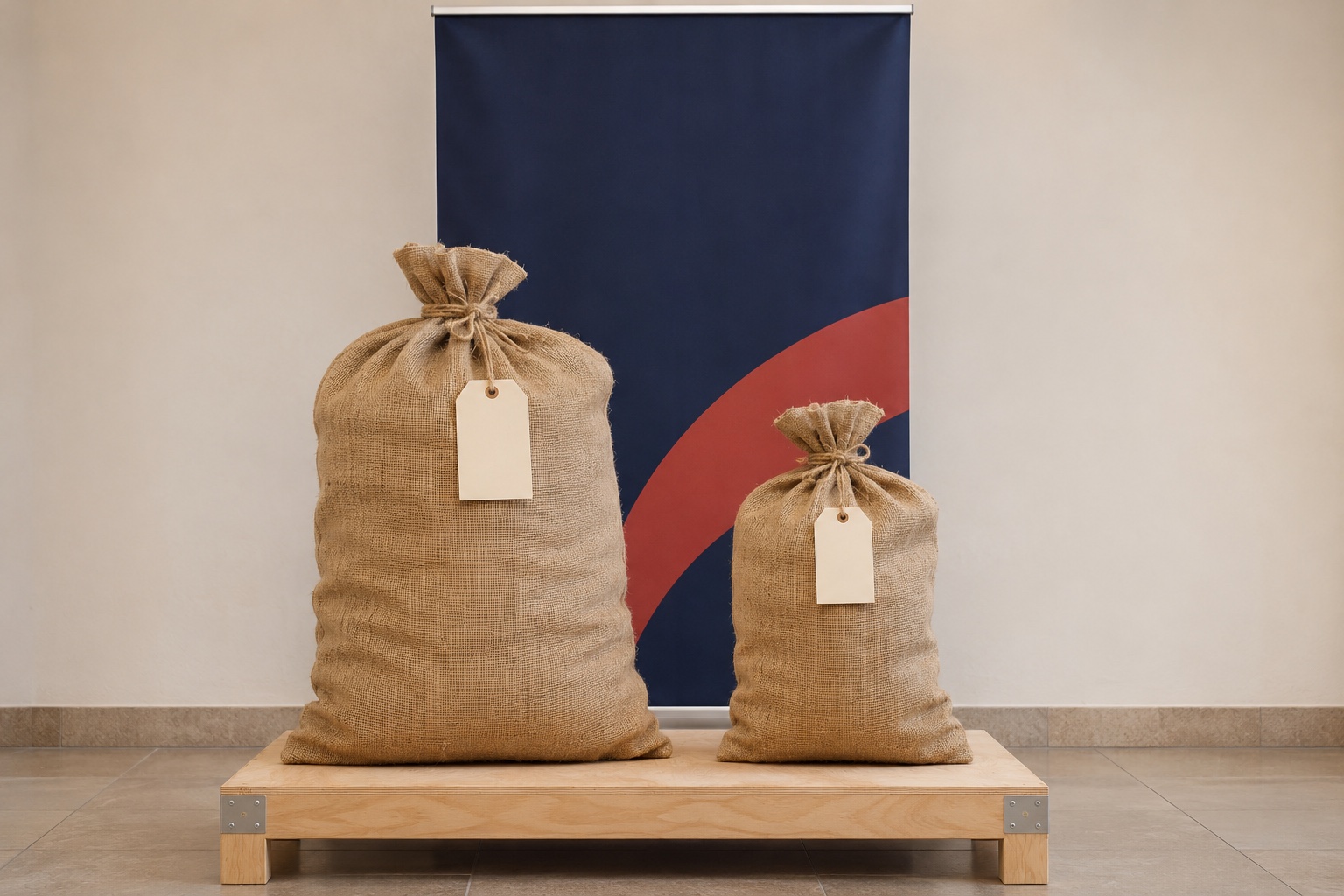
The display places two coffee sacks on one low plinth: 65 kg and 25 kg. Visitors can see the difference in scale without being asked to lift either sack.
The exhibit is a prompt for a research conversation. It does not claim that the effects of either weight have been measured in coffee work.
A volunteer explains what is known about sack weights, what remains unmeasured and why independent research matters. The conversation separates established evidence from the open research question.
The ask is practical: invite Carry the Truth to speak, help connect the research to a suitable institution, or consider supporting a study.
The sacks can be filled locally and set on a low plywood-and-timber plinth. A separate pull-up banner carries the campaign message. That keeps the display straightforward to transport and assemble.
The proposed footprint is about two metres by two, with no power required. Final dimensions would be agreed with the event organiser.
Before an event, the host and the campaign team would agree the risk assessment, supervision, participation limits and insurance arrangements in writing.
These are events where research on manual handling, labour and commodity trade could reach decision-makers and researchers. Carry the Truth is seeking speaking invitations and opportunities to host the display; confirmed engagements will be listed here.
World Economic Forum, Davos · International Labour Conference, Geneva · UN Forum on Business and Human Rights, Geneva · UN Food Systems Stocktake · OECD Forum on Due Diligence in Agricultural Supply Chains · International Coffee Council and World Coffee Conference · ICCO World Cocoa Conference · COP side events
Specialty Coffee Expo · World of Coffee · Re:co Symposium · African Fine Coffees Conference, Kampala, February 2027 · International Coffee Week, Belo Horizonte · Sintercafé · Producer & Roaster Forum · Chocoa, Amsterdam · World Cocoa Foundation Partnership Meeting · Anuga, SIAL, Gulfood and Biofach · PREMUS and the ICOH Congress, where the audience is the one that could run the study
Organise an event? Invite Carry the Truth to speak or host the display. We are also seeking volunteers and partners interested in supporting independent research. See how to get involved.
The letter
One letter, going to about 158 organisations: the traders and roasters who buy most of the world’s coffee and cocoa, the supermarkets that sell it, the national boards that regulate it at origin, the certifiers who write the audit checklists, the development agencies and funders working in these supply chains, the unions representing the people who lift, and the NGOs who have worked on this sector far longer than we have. It asks for two things, and neither is money.
We publish it, in full, before it is sent – along with the name of every organisation it goes to and the state of every reply. Nobody receives a private version, and nobody is quoted out of context, because the text is already here.
There is a second reason for publishing it. A question put privately can be left unanswered without cost. A question put publicly, to a named list, with the answers recorded beside each name, is harder to leave. That is the whole mechanism of this campaign, and we would rather describe it plainly than pretend it is only correspondence.
Dear —
I am writing to you and to about 158 organisations in coffee and cocoa – traders, roasters, retailers, chocolate manufacturers, national coffee and cocoa boards, certifiers, development agencies, unions and regulators. The letter is identical for all of them and is published in full, with the recipient list, before it is sent.
A standard sack of green coffee weighs 60 kg. A sack of cocoa weighs 60 to 65. Between the farm and the shipping container, a person lifts every one of them by hand, usually several times. Your organisation is connected to that lift, whether you buy the coffee, sell it, finance it, certify it, regulate it or set the price at which it changes hands.
Over several months we have tried to establish what that weight does to the people who carry it. Three findings:
1. No one has measured it. There is no published study of the biomechanical load on workers handling 60 kg coffee or cocoa sacks, and none comparing it with a lighter unit under field conditions. The nearest controlled evidence is in cement, where halving a 42.7 kg bag reduced peak spinal compression by about a quarter.
2. The law is largely silent, and where it is not, the sack exceeds it. We examined the labour law of all 187 ILO member States and reached a determinate answer for 134. In 103 there is no kilogram limit on what one adult man may be required to carry. In 27 there is one, below 60 kg. The sack is heavier than the law in every one of those 27.
3. The number was never chosen for safety. It descends from the arroba and the carga, units built around what a pack animal could carry, and was written into the International Coffee Agreement in 1962 as a unit of account. It has not been reviewed since. Meanwhile ISO 11228-1 sets a reference mass of 15 kg for the general working population, with 25 kg as its ceiling.
We are not asking you to change your packaging, your specification, your price or your contracts. We are asking for two things, and neither is money.
First, help get it measured. Any of the following would be material: data on the weights actually handled in your operations or those of your suppliers; access to one site for observation; a contribution to the cost of the work; or an introduction to a research institution that could lead it. The study required is ordinary occupational health science. It has simply never been directed at this.
Second, state publicly that the question is worth answering. We are asking organisations to put their name to a single sentence: that they support independent research into what the 60 kg sack does to the health of the people who move it, and will consider what that research finds. It commits you to no figure, no cost and no timetable.
We would ask for a reply within eight weeks. We will publish the status of every recipient – answered, acknowledged, or no reply – beside their name, and we will publish your response in your own words if you permit it. If you would prefer to correct us rather than reply to us, that is more useful still: every correction we make is published with the date, and we have already published fourteen.
Yours sincerely,
Ketan Patel
The Weight of a Bag — a Carry the Truth campaign
Sent in the recipient’s working language wherever we can. A Spanish and a Portuguese version of this letter and of this site are in preparation.
About 158 organisations, drawn from the Coffee Barometer and Cocoa Barometer company assessments, published trader and importer rankings, the ICO’s own list of national coffee authorities, the membership of the regional trade associations, and the retailers and funders whose names appear on this sector’s sustainability commitments. Nothing has been sent yet. This table fills in as it is.
How we record a reply. Answered means they responded on the substance. Acknowledged means they replied without engaging with the question. No reply means eight weeks have passed. We publish the organisation’s own words where they permit it, and nothing but the status where they do not. If you are listed here and think the status is wrong, tell us and we will correct it the same week.
About
A standard coffee sack holds 60 kg. A standard cocoa sack holds 60 to 65 kg. Somebody lifts every one of them, by hand, at the farm, the buying station, the mill, the warehouse and the port. Almost nobody has asked what that does to them.
The Weight of a Bag is the first campaign of Carry the Truth, a platform about the people whose physical labour carries global supply chains. It argues for one specific, measurable change: cut the standard coffee and cocoa sack from 60 kg to 25 kg, the weight the international lifting standard treats as the maximum reference mass.
The case rests on a country-by-country review of what labour law actually says, on the industries that have already made this change, and on the published evidence about carrying heavy loads. All of it is on this site, with sources, including the parts that are incomplete or that cut against the argument.
The campaign is run by Ketan Patel, who works in certification and assurance for coffee, cocoa and tea supply chains. It is a personal initiative, written in a personal capacity, and does not represent any employer.
I hurt my back lifting a bag into an overhead locker.
It weighed ten kilos. It had wheels. I had carried it through an airport, the way I had carried it through a dozen airports that year, on my way to origin to work on coffee sustainability. There is no dignity in the story and I have told it badly at dinner parties ever since. A man in his fifties, a cabin bag, a bad angle. I did my hand as well, holding the thing at full stretch while I worked out where it was going – a dull ache through the grip that took longer to settle than the back did. Several weeks of being careful about how I stood up, and of opening doors with the other hand.
What stayed with me was not the injury. It was the arithmetic I did while waiting for it to stop.
Ten kilos. Occasionally. On wheels. On a flat floor, in air conditioning, by someone who was going to spend the next three days sitting in meetings about the welfare of the people I was flying to meet. And those people – many of them about my age, because the average coffee farmer is now over fifty – were going to spend those same three days lifting sixty. Not once. Again, and again, and then after lunch. Up a slope, onto a truck bed, off a scale, across a drying patio, into a warehouse stacked six high. In the heat. For a price set on an exchange in New York or London that has never once asked what the sack weighs.
I had spent years of my working life writing and applying standards for coffee. I had read a great many documents about sustainability in this industry, and written some of them. Not one of them had ever asked me to check the weight of the bag. It had simply never come up. The number is written into the 1962 International Coffee Agreement, it is in every contract, and it had become a unit rather than a weight – the way nobody thinks of a gallon as something you have to carry.
So I went looking for where 60 came from. I assumed there would be a reason, and that it would be modern. It is not. It is a pack animal.
In Brazil, where the 60 kg sack began, coffee has always been counted in arrobas. An arroba is 15 kg and a sack is four of them. That is not history – it is this morning. The Brazilian coffee price is quoted per 60 kg sack, and the arroba price farmers use in the field is the sack price divided by four. Cocoa is the same: 15 kg to the arroba in Bahia, 60 kg to the sack in Espírito Santo.
The word arroba comes from the Arabic ar-rubʿ, “the quarter”. It was a quarter of a quintal, and the quarter in question is said to be a quarter of what a pack animal could carry. The old Portuguese arroba was 32 arráteis, about 14.7 kg, which made the quintal 58.75. Brazilian trade rounded the arroba to 15 and the quintal became 60.
If that still sounds like etymology rather than evidence, look at Colombia, where the animal never left. Colombian coffee is not bought by the kilo or by the sack. It is bought by the carga – the word means load – and a carga is 125 kg of dry parchment, ten arrobas of 12.5 kg. The National Federation of Coffee Growers publishes that price every working day of 2026. And a carga, in the reference books, is defined as two sacks of coffee.
Two sacks. One for each side of the animal.
The dictionaries are blunter still. A Nicaraguan lexicon gives the carga as “the load a mule can carry”, eight arrobas, about 90 kg. An Argentine source gives the mule’s carga as twelve to fourteen arrobas. A Costa Rican government report of 1885 fixes the export carga for coffee at twelve arrobas, 115.015 kg. The numbers differ because mules differ. The principle does not.
There is a competing account, told in the Italian trade, that puts the sack at one side of a mule directly, without the arroba in between. And a third, in the standard reference work on coffee, which says bag sizes “were originally determined by what a man could reasonably carry on his back”. I cannot tell you which is true, and the etymological link between the arroba and the animal is trade lore rather than documented fact – the most-repeated version of it carries a citation-needed tag on the internet’s own account of itself.
But every version agrees on the thing that matters. The unit was set by what an animal could carry, or by somebody’s nineteenth-century guess about a man’s back. Not one version involves measuring a person, because when the number was fixed there was nothing to measure with and no particular reason to think it mattered.
We have had the instruments for about fifty years. In Colombia the price of coffee is still published in mule-loads. The sack has not changed.
So this started as an embarrassment rather than a cause. I am not an ergonomist and I have never loaded a truck for a living. What I had was a particular kind of uselessness: enough knowledge of this industry to know how it writes its rules, and no idea at all why this one had never been written. I went looking for the law that permits a 60 kg sack, expecting to find it and to feel foolish.
It is not there. In most countries there is nothing at all – no number, no limit, no rule. In twenty-seven, the law already says one man may not carry this much, and the sack is heavier than the law. The silence I expected to be a decision turned out to be an oversight that has lasted sixty-four years.
My back was fine in a month. I had the luxury of being careful. The whole of this campaign is the question of what happens to someone who does not.
If a figure here is wrong, outdated or missing a source, it should be corrected. The same goes for any country marked as not yet researched. Every entry names the law it came from, so any claim here can be checked against the text. From the day this site goes live, every correction we make will be published with the date.
Contact details for corrections and enquiries are not available yet. They will be published here.
There is a page for this: Get involved. In short, we are asking the trade to back independent research into what the sack does to the people who move it, before anyone is asked to change it. If you buy coffee or cocoa, ask your supplier what the bag weighs. If you work at origin, tell us what workers actually carry and how far – that evidence barely exists. If you know a country’s law better than this site does, send us the text. #WhatDoesYourCoffeeWeigh
Data notes
The map draws on a country-by-country review of what the labour law of each of the ILO's 187 member States says about the weight one worker may lift or carry. For each country it records the legal instrument and article, the limits for adult men, adult women, young workers and pregnant workers, whether the rule is binding law or guidance, and a link to the source. Where a figure exists, the file answers one question: can one adult man lawfully carry a 60 kg sack?
Wherever possible, figures are read from the official text of the law – the gazette, the government's legal database or the labour ministry's own publication – rather than from summaries. Each country entry carries a confidence rating: High where the legal text itself was read, Medium where it rests on a reliable secondary source or a partial text, and Low where it has not yet been confirmed. The rating is shown in every country's file so that readers can weigh each figure for themselves.
As of 28 November 2026, of the 187 member States: 157 have been examined and 30 have not been researched at all. Of the 157, we reached a determinate answer for 134: 18 were searched without a clear answer and for 5 more the position is unresolved. Those 134 are 103 with no kilogram figure for adult men, 27 with a figure below 60 kg, two at or above it (Brazil and Haiti) and two whose law is read as effectively setting none (Italy, Slovenia). Confidence is bucketed by the first word of the rating, so a row marked “High (figures); Medium (status in 2026)” counts as High: on that rule 52 are High, 62 Medium and 43 Low, and 18 were searched without reaching a clear answer. 150 name a specific legal instrument and 151 carry a source link. Nobody has read every word of 187 labour codes, and this site does not claim to: it claims to show, for each country, what was found, where it came from and how far it can be trusted.
Coffee, cocoa, grain and cement bag sizes are trade practice unless the country's notes cite a law or standard. A country is given a figure only where a source names that country: Colombia's 70 kg export sack comes from the growers' federation's own resolution, Ghana's 64 kg bag from the cocoa board's price announcement. Producing countries with no country-specific source are shown as “size not confirmed” rather than coloured in from a regional average. Grain and cement sizes appear only where a source was found.
Corrections and additions are welcome, and will be published with the date. Every figure on this site can be traced to its source. Country borders come from the ECharts world map and are shown for orientation only. Last updated 28 November 2026.